An Ethereum Foundation initiative

Extending self-sovereign coordination to new domains

Use Case Lab identifies domains where people are stuck coordinating through unnecessary intermediaries helps lay the foundation for open alternatives.

Intensive collaborative sprints where builders and domain experts prototype solutions to problems no single team would tackle alone.
Ethereum Unblock SF
Upcoming

Ethereum Unblock SF

Mar 9–13, 2026 · ETHSF
Five days with Silicon Valley product teams working on the missing pieces — the primitives, protocols, and patterns that multiple real-world use cases need but no single company would build alone.
Register on Luma ↗

Argentina Onchain
Completed

Argentina Onchain

Nov 1–14, 2025 · Edge City Patagonia
Argentine institutions are experimenting with on-chain coordination faster than almost anyone. We spent two weeks understanding what they need, what's working, and where Ethereum falls short.
Read the report (w/ BlockchainGov) ↗

If you're working on a real-world use case for Ethereum, we'd like to talk.
← Back

Verifiable Cities

Cities lack cross-agency coordination capacity, constraining service delivery and policy execution. Cryptographic technologies can make municipal operations verifiable, composable, and privacy-preserving — moving from institutional trust to technical proof.

Capture risk

Cloud platforms and "smart city" vendors create dependency and lock-in at the infrastructure layer. Cities that adopt proprietary civic tech often can't switch providers, audit algorithms, or even access their own data without the vendor's permission.

Exit story

Every primitive must be forkable and vendor-neutral — rules maintained at the policy layer, not the platform layer. If a city adopts a verifiable service delivery system, it should be able to swap out every technical provider without losing state or history.

Example apps

ZK-verified benefits eligibility without exposing personal data Real-time disaster relief payments triggered by sensor data Municipal bonds with on-chain outcome tracking Cross-agency data sharing with cryptographic access control Auditable AI-assisted policy decisions Citizen-verifiable budget execution

The landscape

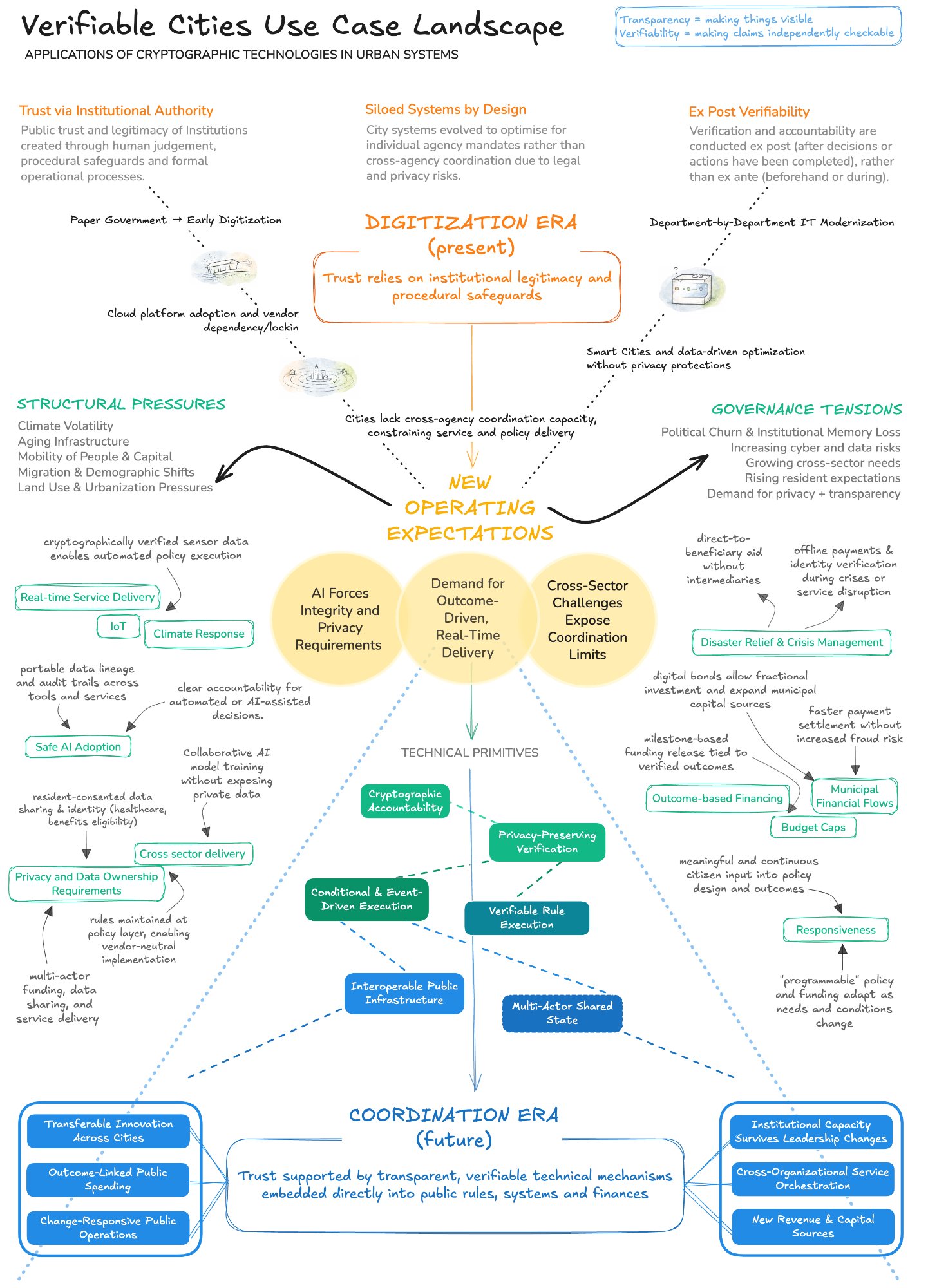
Verifiable Cities Use Case Landscape

Today, trust in city operations relies on institutional legitimacy and procedural safeguards. Systems are siloed by department, optimized for individual agency mandates rather than cross-agency coordination. Verification happens after the fact — audits, reports, investigations — rather than being embedded into the systems themselves.

This creates a gap between what cities promise and what they can verifiably deliver. Climate volatility, aging infrastructure, demographic shifts, and rising citizen expectations are widening that gap.

The thesis

Cryptographic primitives — verifiable computation, zero-knowledge proofs, programmable commitments — can underpin a new operating layer for cities. One where service delivery is verifiable in real-time, cross-sector coordination is technically enforced rather than politically negotiated, and citizen data stays sovereign while still enabling data-driven governance.

Privacy is non-negotiable here: residents must be able to prove eligibility for services without exposing personal data. Censorship resistance matters too — verifiable public records can't depend on any single authority's willingness to keep publishing them.

The path runs from the current digitization era — where trust relies on process — toward a coordination era where trust is supported by transparent, independently checkable technical mechanisms embedded directly into public rules, systems, and finances.

All research, specifications, and reference implementations produced under this track are published openly under permissive licenses.
← Back

Open Telematics

Telematics data — from vehicles, sensors, devices — is captured by platforms that monetize it without user consent or compensation. An open, Ethereum-native standard can return data sovereignty to the people and communities generating it.

Capture risk

OEMs and fleet platforms treat telematics data as a proprietary asset. Once a device reports to a centralized backend, the user has lost control permanently — there is no "undo" for data exfiltration. New intermediaries (data brokers, aggregators) emerge to resell what users never consented to share.

Exit story

The standard must be device-agnostic and platform-independent. A user switching vehicles, providers, or countries retains full control of their data history. No single node, company, or protocol upgrade can revoke access to data a user has already signed.

Example apps

Driver-owned trip data that insurers bid to access Community air quality meshes with token-gated data feeds Permissionless fleet logistics across competing operators Verifiable location proofs for delivery and compliance Vehicle health attestations for peer-to-peer car sales

// data flow problem

3.2B Connected vehicles by 2030
25TB Data per vehicle / day
~0% User-controlled

Every connected device is a data source. Vehicles alone generate terabytes daily — location, speed, diagnostics, environmental readings. This data flows upward to platform operators, insurers, advertisers, and governments. The people and communities producing it have no say in how it's used, no way to audit who sees it, and no mechanism to capture value from it.

// the open standard

We're working toward an Ethereum-native telematics data standard: a protocol-level specification for how sensor data gets signed, attested, stored, and permissioned — with user keys as the root of control. The goal is that any device implementing the standard produces data that is cryptographically owned by the user, selectively shareable via onchain permissions, and composable across applications without intermediary extraction.

This intersects directly with usage-based insurance (parametric coverage triggered by verified driving data), fleet coordination (permissionless logistics networks), and environmental monitoring (community-owned air quality or noise sensor meshes). Security at the device-signing layer is foundational — compromised attestations undermine everything downstream.

All research, specifications, and reference implementations produced under this track are published openly under permissive licenses.
← Back

Composable Commerce

Real-world trade still routes through intermediaries that extract at every layer — payment processors, marketplace platforms, supply chain clearinghouses. Ethereum can make commercial coordination composable, borderless, and self-sovereign.

Capture risk

"Decentralized marketplaces" that introduce new gatekeepers at the indexing, reputation, or dispute layer. Protocol-level fee extraction that recreates the platform tax in a different form. Composability that works only within a single ecosystem.

Exit story

A merchant using composable commerce primitives can switch to a different front-end, a different settlement layer, or a fully self-hosted setup — and take their reputation, transaction history, and customer relationships with them. The coordination layer is shared; the exit door is always open.

Example apps

Portable seller reputation you take between marketplaces Coffee bean provenance verified from farm to cup Escrow that releases on verifiable delivery confirmation Cross-border B2B settlement in minutes, not weeks Buyer-seller dispute resolution without a platform arbiter

The extraction stack

LayerIntermediaryTypical extraction
PaymentsProcessor / card network1.5–3.5%
MarketplacePlatform (Amazon, Shopify)6–20%
LogisticsClearinghouse / broker3–10%
Dispute resolutionPlatform / chargeback system1–2% + friction
ReputationPlatform-locked reviewsLock-in (non-portable)

Each layer in the traditional commerce stack introduces an intermediary that extracts value and creates lock-in. A seller on a major platform loses 20-30% of gross revenue to fees before accounting for their own costs. Worse, their reputation, customer relationships, and dispute history are trapped inside the platform — you can't take your Amazon reviews to a competitor.

Composable primitives

The path forward isn't replacing Amazon with a "decentralized Amazon." It's building composable primitives — programmable escrow, portable reputation attestations, verifiable supply chain proofs, peer-to-peer invoicing — that any builder can assemble into commerce experiences where participants set their own terms. The coordination layer is shared and permissionless; the applications on top compete on experience, not on lock-in.

Censorship resistance is the quiet requirement: a commerce layer that can be shut down by a single jurisdiction or provider isn't an improvement over the status quo, it's a relabeling of it.

All research, specifications, and reference implementations produced under this track are published openly under permissive licenses.
← Back

Global Insurance

Traditional insurance pools risk through opaque institutions that profit from denying claims. Programmable, parametric models on Ethereum can create transparent safety nets that cross borders and serve their members rather than their shareholders.

Capture risk

On-chain insurance pools governed by token-weighted voting can reproduce the same dynamics as shareholder-controlled insurers — where the pool's governance optimizes for returns rather than coverage. Oracles become new chokepoints if payout triggers depend on a single data source.

Exit story

Members can withdraw from any pool at any time, subject only to transparent, pre-committed lockup terms. Policy logic is auditable. No single oracle, governance token holder, or protocol upgrade can unilaterally block a valid claim.

Example apps

Crop insurance that pays out automatically when rainfall drops below threshold Mutual aid pools governed by members, not shareholders $2/month microinsurance for unbanked communities Cross-border climate disaster pools without reinsurer extraction Health coverage with ZK-verified claims — no medical data exposed

How claims could work

1
Trigger event occurs

An oracle reports that rainfall in a region dropped below the policy threshold for 30 consecutive days.

2
Smart contract verifies

The policy contract checks the oracle data against the parametric condition. No human adjuster, no paperwork, no discretionary denial.

3
Automatic payout

Funds release from the pool to all qualifying policyholders. Settlement in minutes, not months.

4
Pool rebalances

The mutual pool recalculates premiums and reserves transparently. All members can verify the math.

The global insurance gap — the difference between insured and actual economic losses — exceeds $1 trillion annually. Most of the world's population has no access to meaningful coverage. The industry's structure, built on extractive intermediation and adversarial claims processes, makes expansion into underserved markets unprofitable by design.

Ethereum changes the denominator. Programmable risk pools with automatic, verifiable payouts strip out the overhead that makes micro-coverage uneconomical. Mutual structures governed by smart contracts align the pool's incentives with its members. And interoperability means a farmer in Kenya and a shop owner in Colombia can participate in the same global risk pool without a reinsurer in London taking a cut.

Privacy matters acutely here: health data, location data, and financial exposure cannot be visible on-chain as a condition of coverage. Zero-knowledge proofs of eligibility and loss are essential, not optional.

All research, specifications, and reference implementations produced under this track are published openly under permissive licenses.
← Back

Automated SMEs

Small and medium businesses drown in administrative overhead — invoicing, compliance, contract management, payroll. Self-executing workflows on Ethereum can automate the back office while keeping business owners in sovereign control of their operations.

Capture risk

SaaS ERP platforms that "integrate with blockchain" while keeping data and workflow logic proprietary. Smart contract templates controlled by a single vendor. Automation tools that require ongoing subscriptions to maintain access to your own business logic.

Exit story

A business running on self-executing contracts owns its workflow definitions, transaction history, and counterparty relationships outright. Switching providers means changing a front-end, not migrating your business. The contracts keep executing regardless.

Example apps

Invoice auto-generated and settled when shipment GPS confirms delivery Payroll that executes on-chain every two weeks — no processor needed Freelancer contracts with milestone-triggered payments Tax compliance docs generated from on-chain transaction state Multi-party supply agreements that self-execute across jurisdictions

A typical business workflow, on-chain

Agreement signed
Milestone delivered
Verified on-chain
Auto-settlement

An SME owner today manages a patchwork of SaaS tools for invoicing, contracts, payroll, and compliance — each one a separate vendor relationship, a separate data silo, a separate monthly fee. The administrative burden scales linearly with the business, consuming time and capital that should go to the actual work.

The core insight is that most business-to-business agreements are already structured as conditional logic: if X is delivered by Y date, then Z payment releases. Ethereum makes this logic executable. A contract between two businesses becomes a smart contract — not metaphorically, literally. Delivery milestones can trigger invoicing automatically. Payroll can execute on schedule without a processor. Compliance documentation can be generated from verifiable on-chain state rather than manually assembled for auditors.

The challenge isn't technical complexity — it's making these workflows accessible to business owners who don't think in terms of blockchains. The resident for this track will work at the intersection of ERP/accounting software and Ethereum primitives, building bridges that feel like better business tools rather than crypto products.

All research, specifications, and reference implementations produced under this track are published openly under permissive licenses.